
Not “One Size Fits All”: How NFP Size Affects Data Projects

Updated: Jun 29

Introduction
Good Data Institute has worked with charities of all sizes - from household names with over $100 million in annual revenue to small organisations with only a handful of volunteers. To ensure the success of a data project, it is critical to tailor the approach and aims of each project to suit the needs of each charity partner. Larger charities and smaller charities have key differences in 3 major areas that we have to understand to ensure the data project delivers value within the context of their current operations.
1) People
Within a large not-for-profit organisation, resource allocations and headcounts often enable employees to be more specialised. In the data space, this may mean that there are separate roles for different aspects of data and analytics: business analysts, data analysts, business intelligence developers, data scientists, data engineers, data governance, CRM managers, and systems engineers, for example. Each of these specialists would be specifically trained in their area of expertise. This enables the development of more complex solutions, understanding that the organisation will have the ability to maintain and use the solution after the development is complete. This also means projects are likely to be more specialised and geared towards solving a specific problem faced by a certain team, rather than organisation-wide reporting or tracking solutions which would already be in place.
In contrast, smaller organisations require generalists who have the skills to handle multiple domains and skillsets. One person may handle everything related to data, or there may not even be a dedicated data specialist, as was the case during my engagements with The Hunger Project Australia and Brother 2 Another. This meant that our project, while dealing with lower volumes and scale of data, was broader in scope. The Brother 2 Another project, for example, started with the development of a basic data collection mechanism in Google Forms, leading into creating data pipelines that flowed into Power BI, for which we also handled the setup of the Power BI infrastructure and licensing. In much larger organisations, these would likely have been handled by a few different departments, each with specialised expertise in specific parts of the project.
Small NFPs may also rely on external partners for IT or data services which larger NFPs will likely have in-house, which may affect the way solutions are deployed and have meaningful considerations with regards to data security and privacy obligations.
2) Process
A large, established not-for-profit organisation likely already has a significant base of existing tools - potentially in the form of software, dashboards, spreadsheets, and workflows. This means that new solutions that are developed will need to work within the existing framework and processes. For example, when I develop a new dashboard for a large organisation with thousands of employees, I follow the formal processes and guidelines with regards to visual standards, testing, documentation, and access controls. I also ensure that it can be used within existing workflows to improve adoption - for example, a financial dashboard may be shown in a weekly meeting discussing projections for the coming week.
A small organisation, on the other hand, is likely to be at the start of their data journey. My projects with The Hunger Project Australia and Brother 2 Another both represent the first Power BI dashboards in the respective organisations, for example. This brings the opportunity - and responsibility - of having a clean slate, where we work with each organisation to define standards, best practices, and ways of adoption, with no precedent to base it off. A large consideration here is to ensure that the organisation is well-placed to maintain these processes after their engagement with GDI ends.
3) Technology
In choosing the right tool for a project, it is crucial to understand that the best tools for a small NFP may be different to what would be suitable for a larger NFP. Some key considerations include features, ease of use, and cost, as will be explored below in the context of CRM tools, database solutions, and visualisation tools.
CRM: Our engagement with Brother 2 Another involved building a simple CRM system based on Google Forms and Google Sheets which enables them to track the activities and outcomes associated with their mentoring sessions with Indigenous youth. The scale of this data was relatively small, and there were no existing solutions that served their specific needs out of the box given the range of outcomes they would like to track. Furthermore, it was critical that all staff, regardless of their familiarity with technology, are able to input data. In this context, the use of Google Forms enabled an easy-to-use, customisable tool that tracked exactly the metrics and outcome that they needed.

Meanwhile, The Hunger Project Australia used Raiser’s Edge, an off-the-shelf dedicated CRM system to manage fundraising and donor activities. As their most prominent requirement is donor management, which is extremely common and has plenty of gold standard solutions available, a custom CRM tool is not required given their circumstances. Furthermore, as a larger organisation, the use of established tools allows them to access vendor support and best practices in terms of ensuring data governance and data quality, which would have required significantly more effort and resources to manage with a custom tool for an organisation of their size.
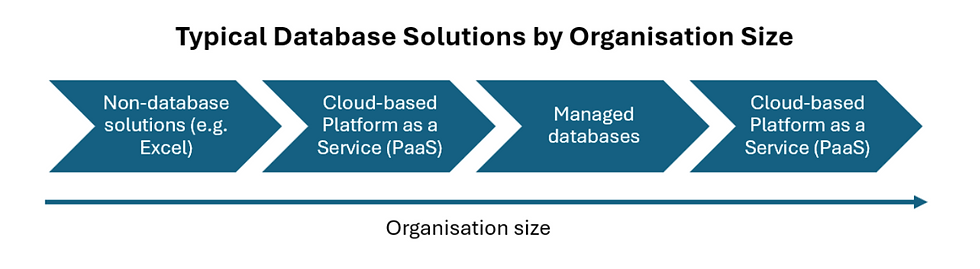
Database solutions: A very small organisation may not require a dedicated database to manage their data, with volume and complexity of data that are manageable through spreadsheets and files - as long as the right processes are in place with regards to version control, data governance, access management, and data quality. As the organisation scales, this may no longer be sufficient, and a dedicated data management solution is required. In the first instance, it is often sensible to utilise cloud solutions, where setup costs are minimised due to having a managed service, avoiding the need to have in-house specialists and hardware infrastructure. As these solutions often charge based on the volume of data stored or processed, relatively small organisations taking their first steps in dedicated data management often find this to be the most cost-effective solution, having lower data volumes.
When the organisation grows even further, the flexibility provided by a dedicated, on-premise, managed database may become a more important factor, making it a more attractive option. The economics may also support this, as data volumes increase making cloud solutions more costly while an on-premise server has lower running costs after the initial investment. It is worth noting, however, that the largest organisations managing terabytes or petabytes of data at once often revert back to cloud solutions which are better suited to scaling at the highest levels.
Similar considerations also apply to other software, such as data visualisation tools, where cost structures can be nuanced. This highlights the importance of choosing the right tool and licensing structure that fits the organisation, the complexity of their needs, and their budgetary constraints. For more details and examples of how we select the right data visualisation tool for a charity partner, visit the following article: Which Data Visualisation Tool is Best for NFPs? A Comparison Guide
Key Takeaway
When undertaking a data project for a NFP, achieving successful outcomes requires that the solution be tailored to the context and circumstances of the organisation. The size of the charity is one critical part of this context, which has important implications for the tools chosen and the way the solution is integrated into the organisation’s existing processes. Understanding this allows us to build high-value, maintainable solutions that are best suited to the NFP’s current state in terms of human resources, existing workflows, and technology stack.
About GDI:
The Good Data Institute (established 2019) is a registered not-for-profit organisation (ABN: 6664087941) that aims to give not-for-profits access to data analytics (D&A) support & tools. Our mission is to be the bridge between the not-for-profit world and the world of data analytics practitioners wishing to do social good. Using D&A, we identify, share, and help implement the most effective means for growing NFP people, organisations, and their impact.


Connector coverage and sync reliability tend to matter more than feature checklists in practice. A selection of automation platforms gives a clearer picture of which tools actually integrate with the apps you already use.