
A Day in the Life of the GDI Data for Good Cohort

Updated: Aug 18
A common question we hear from prospective volunteers is: what is it actually like to be part of the Good Data Institute's Data for Good Cohort?
From the outside, it can be hard to picture what the experience involves. Is it a course? A hackathon? A volunteer project?
The answer is... a little bit of everything.
The Data For Good Cohort is designed to help volunteers build practical experience solving real-world challenges for not-for-profit organisations, while becoming part of a community of people who believe data can create positive social impact.
Over a few months, volunteers take part in onboarding sessions, learn from experienced practitioners, collaborate in a team hackathon, and have the opportunity to contribute to live client projects.
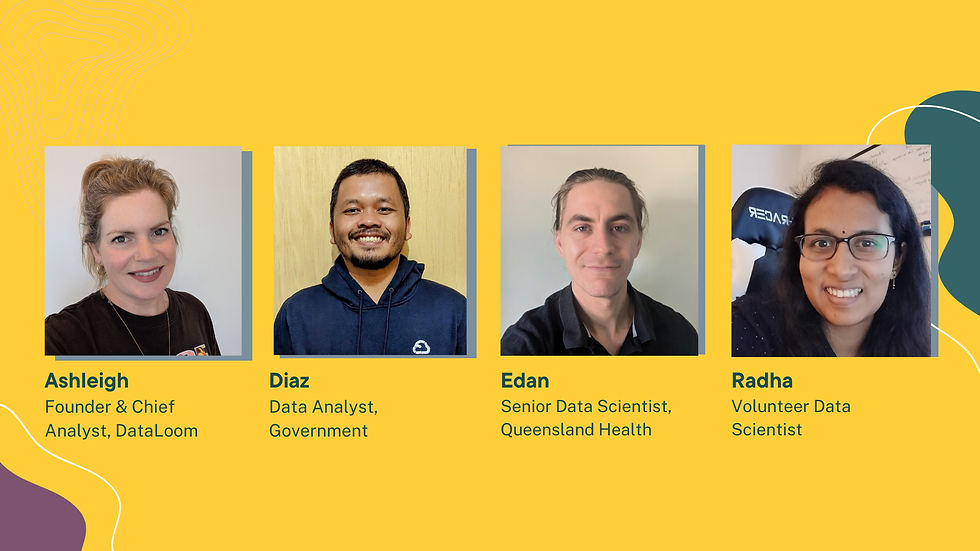
To give you a behind-the-scenes look, we asked four members of our 2025 cohort to share what surprised them, what challenged them and why they'd recommend the experience to others.
Meet the featured volunteers from the 2025 cohort
It starts before the first meeting
For many volunteers, the experience begins long before the first workshop. There's the application process, the interviews, and the excitement of receiving that email.
Ashleigh remembers wondering what the next few months would hold.
"Having been through the interviews and then selected for the cohort, there's already a buzz before the first group meeting. Who will I meet? What will we learn? What can we achieve?"
Those first weeks are dedicated to onboarding, where volunteers build a shared understanding of how GDI works with not-for-profits. Sessions cover everything from project delivery and stakeholder engagement through to data ethics, helping everyone start from the same foundation regardless of their background.
For Ashleigh, the ethics session stood out immediately.
"My favourite session was Data Ethics. It's crucial in general, but especially when working with not-for-profits because of the sensitive nature of the data they're entrusted with."
Alongside the learning sessions, volunteers are introduced to one another through the cohort hackathon. Working in small teams, they tackle a real challenge provided by one of GDI's not-for-profit partners. This time around we partnered with We Are Mobilise, a Direct Giving platform that moves money from funders to housing providers, through 50+ charity partners nationwide.
For Diaz, it was the first chance to experience what "data for good" really looks like.
"A typical week involves knowledge sharing from the executive team before diving into real-world data, brainstorming with teammates, and iterating on analysis and dashboards that help not-for-profits make better decisions."
Radha's team explored homelessness risk forecasting, developing a solution that could help the organisation better understand demand and strengthen future funding proposals.
"Our team partnered with Mobilise to develop a Homelessness Risk Forecasting Model. The goal was to help them proactively adjust resources based on risk factors and strengthen funding proposals with data-driven evidence."
For many volunteers, this is where everything clicks. The learning becomes practical, and the impact becomes tangible.
Everyone brings something different
One thing every volunteer mentioned was the diversity of the cohort. Some members are experienced analytics leaders with decades in industry. Others are students, parents, founders, or simply data professionals looking to build confidence. That mix is one of our cohort's biggest strengths.
Ashleigh describes it as finding "part of a life tribe."
"Although we all have a vast range of skills and experiences to offer, knowing that we all come together under the GDI mission is like finding part of a life tribe."
Working with people who think differently isn't always straightforward. Teams often need time to establish shared ways of working, particularly when everyone brings different technical knowledge and experiences to the table.
Ashleigh says that process became one of the biggest lessons of the program.
"It took us a few meetings to establish a baseline level of understanding. It was such a good reminder that good collaboration starts with communicating and recognising what each person brings to the table."
But once that foundation is built, the results can be remarkable.
"Seeing how other teams approached the same challenge was eye opening. There are so many ways to apply data solutions to problems."
For Diaz, collaboration became one of the defining parts of the experience.
"Everyone brings something different to the table, and we all learn from each other."
Learning by doing
The Data for Good Cohort is also a great place to experiment with new tools and technologies. Across the cohort, volunteers worked with Python, SQL, Power BI, Streamlit, DuckDB, GitHub and Google Workspace. They were also required to communicate with stakeholders, collaborate in multidisciplinary teams and translate technical work into practical outcomes for not-for-profits.
For Edan, who recently transitioned into data, the hands-on experience accelerated his learning.
"You never learn faster than by working on real projects with strong, supportive team members. Our hackathon project finished runner up and I was over the moon with how it all turned out."
Diaz echoed this sentiment.
"I developed my technical skills, especially with Python and Streamlit for data visualisation, and learned to communicate clearer, data-driven findings to stakeholders."
Ashleigh says the experience also filled important gaps in her own knowledge.
"The engagement I'm currently working on is allowing me to see the entire ETL process from start to finish, whereas in my last job I was only ever privy to the end databases."
Radha found a lesson that wasn't technical at all.
"It helped me see data through a new lens, one of empathy and impact. Every number represents someone's experience."
Life doesn't stop, and that's okay
Like most volunteers, cohort members fit GDI around full-time jobs, study and family life. Projects are intentionally designed with that in mind, with volunteers typically contributing a few hours each week.
For Edan, that flexibility made it easy to stay involved.
"I can do my work on a weekend, after work, or even between uni classes."
Ashleigh balances volunteering alongside running a business and raising two young children.
"I let my partner know so they could adjust their schedule to allow me more time to focus. It's only intensive while you're on a project, and it's absolutely worth it."
She mentioned her daughter regularly appearing on video calls.
"Unlike a corporate environment, the GDI community was very relaxed about the parental juggle. I could easily spot the fellow parents. They were the ones pulling faces back at her."
More than volunteering
Every volunteer described GDI a little differently, but there was plenty of overlap. They spoke about learning new skills, working alongside generous teammates and using their expertise to contribute to something meaningful.
For Radha, GDI is "the perfect intersection of purpose, passion and problem solving."
Ashleigh describes it as "a constant reminder of the good in the world."
Edan sees it as "an opportunity to learn, grow, apply my skills, and help others."
And Diaz says it's about "joining a community that believes data can drive change."
Thinking about applying?
If you're looking for an opportunity to grow your data skills while contributing to meaningful work, we'd love to welcome you to the next Data For Good Cohort.
Ashleigh encourages future volunteers to invest in the people around them.
"Take the time to learn about the humans you're working with. You'll be rewarded with incredible ideas and countless tips and tricks you can take back into your own work."
Diaz hopes applicants embrace the challenge.
"Be prepared to learn new things, challenge yourself, and work with inspiring people."
Edan has one simple message.
"Working on real-world projects with real social impact is 100% worth the time investment."
And for Radha, the cohort has only reinforced her desire to keep contributing.
"The hackathon gave me a glimpse of what's possible when collaboration meets purpose. Now I can't wait to experience the full project journey."


This deep dive into the GDI Data for Good Cohort offers such an inspiring look at how people are leveraging data for positive social impact. It’s wonderful to see the focus on practical experience, real-world challenges for non-profits, and the collaborative environment – what an incredible way to develop skills and contribute! Speaking of diverse teams and connectivity, if any of these dedicated folks or other readers are planning a trip, say to Malta, reliable internet access is always a key consideration. As someone who works with Cellesim, I've seen firsthand how an eSIM can simplify staying online while abroad, offering a really straightforward way to get connected, like with a https://cellesim.com/es/esim-malta plan.
As explored on https://34.ua, which frequently highlights professional development, the intersection of technology with social impact, and modern career pathways, the post from Good Data Institute titled A Day in the Life of the GDI Data-for-Good Cohort offers an intimate look into the rigorous and rewarding process of leveraging data science for humanitarian objectives. This publication underscores the reality that high-level technical skills, when paired with a clear altruistic mission, can serve as a potent force for addressing systemic challenges in the non-profit sector. It highlights how participants navigate complex datasets, collaborate across multidisciplinary teams, and translate analytical insights into actionable strategies that directly benefit mission-driven organizations.
The core narrative demonstrates that the Data-for-Good cohort model is fundamentally about bridging the talent…